Two blog posts ago, I started talking about different aspects of our language arts curriculum. In that first blog post, I focused on writing. In the final installment, I will be looking at our approach to literature circles. This blog post is dedicated to WORD WORK. What is word work, you might ask? Well, in a nutshell, just as it sounds - work that is focused around the study of words. We are guided by a curriculum called, Words their way. LGA students have been doing a lot of work focused on figuring out patterns of words, looking at their meanings, spelling these words, and truly understanding vowel-consonant constructions.
Weekly, LGA students starting in grade 1, are given odd sheets like the example above. During language arts times throughout each week, students are grouped to work together on all of the tasks that I listed in the last paragraph. When I walk through the hallway during a language arts block, I often see students playing games with these words, quizzing each other on meaning and spelling, and trying to put these words into sentences. Students become word sleuths. They look for patterns that emerge. This year, we are asking students to think deeper about words.
Why is word work so important? Vocabulary building, spelling, understanding how words develop is essential when creating a robust language arts curriculum. Some reasons that schools use word work are to create ways for students to connect with the English language and to build an arsenal of tools that will assist them as they graduate from grade to grade.
This year, I have seen a consistency of practice that I haven't seen before at LGA. Faculty members report that there is rhythm to the work and many students appreciate the regularity of the pace. Next time, you are with an LGA student, ask them about the games they play with their words. Many times you'll see them get excited to explain it to you.
As we prepare to have our students take standardized tests, we will be evaluating if we see any early results from the work that we have done. Stay tuned to find out more...
At LGA, we assess our students constantly when they are doing word work. It is individualized. It is independent. It is working with small groups or in a pair. It is asking students to think differently about words. It is not a spelling program.
Wednesday, April 25, 2012
Thursday, April 5, 2012
Chag Kasher v'Sameach
I am interrupting my blog posts about our language arts curriculum to share with you some Pesach well wishes. Chag Kasher v'Sameach!
Today is the last day of school before Passover vacation starts. The building is buzzing. But more importantly, the place smells like Pesach. Today, every student brought a vegetable so that we can have a giant pot of vegetable soup for our school-wide Passover meal. Everyone is busily getting ready for the all-school seder. Sixth grade is debuting their giant seder plate display that they worked on in art class.
Gan students are cleaning their classrooms and cubbies. Some of the members of Kitah Bet are getting ready for their Hebrew play which retells the exodus.
Today is the last day of school before Passover vacation starts. The building is buzzing. But more importantly, the place smells like Pesach. Today, every student brought a vegetable so that we can have a giant pot of vegetable soup for our school-wide Passover meal. Everyone is busily getting ready for the all-school seder. Sixth grade is debuting their giant seder plate display that they worked on in art class.
| Members of Kitah Vav along with art teacher, Morah Kitty, designed a giant seder plate for the entire school to see during our seder. |
| Members of Kitah Bet getting into their parts as they take the stage to tell the Passover story. |
Throughout our curriculum, students are interacting with Pesach in real ways. If we were to focus on one big central question that we want to have our students ponder at Passover, it would be, "How and why do we remember important moments in history that have impacted who the Jewish people are today?"
These moments are significant and many in the school. They are woven into all aspects of our curriculum. They are transmitted in all different ways. Students are given a rich landscape to explore this question. At LGA, we fully believe in integrating the arts in all aspects that we do. We also believe that this looks different for all ages.
Look at how Gan has been introduced to the seder. They created a hagadah. They made matzah. As soon as you walk in the doors of the school, you are greeted with instructions on how to make matzah. Take a look at Morah Amy's blog about how she creatively introduces Passover to her class.
Then take a peek at how Kitah Vav (6th grade) delves deeper, creating a piece of art work that will hopefully last for future generations of LGA students to use and study from. They research in-depth the individual parts of the seder plate.
This surely isn't the way that I learned about Passover. The LGA students are excited to share with their families all that they have studied. I will leave you with two things to look at. One is the Gan hagadah and second are these students singing "The Four Questions."
So on behalf of the entire LGA community, Chag Sameach!
Monday, March 26, 2012
The budding authors of Grade 3...
One initiative that has taken shape over the last few years that I am most proud of is our outstanding language arts program. The direction this curricular strand has taken over the last few years has been incredible and eye-opening for the entire faculty. We have done a lot of self-assessment and research to understand what best practice looks like in other excellent schools. Our faculty has worked to create a program that prepares students with a comprehensive language arts experience. The next several posts are going to focus on three different strands of the language arts curriculum - writing, word work, and literature circles, with examples of each and discussion of why we focus on them.
Let's start with the why. I can give you all of the normal reasons, but the fact of the matter is that in a dual-curriculum school, finding time to really write can be challenging. I mean, our students do plenty of writing, but the kind of writing I am talking about is the sort that gets our students to think and explore, where the students show teachers their deeper understanding. The kind where students become passionate about who they are as writers. As educator and curriculum developer Lucy Calkins wrote, "When your writing is lousy, you throw it out. When your writing is alive and beautiful and full of potential, you revise it. Revision is a compliment to good writing!" I am proud to say this type of writing is now an important focus of our language arts work. The difference is in the caliber of the writing being produced in our classrooms.
Julie Kearns's grade 3 students have become authors, with the end product being a bound book that will become a part of their personal library. The process of writing has become fully embraced by this class, but it's more than that. For the past two Monday mornings, students in her class have stood up at Monday Morning Meeting, in front of the entire school, and read us their works of literature. Each work was different and alive with emotion. They are not only learning the art of writing, they are becoming public speakers, they are becoming illustrators. They are beginning to understand what a multifaceted writing assignment looks like, and that being an author is more than just writing the words on a piece of paper. It is delving deep and truly find meaning in the words that you choose.
I am sharing with you a few examples of pages from one of the books. I perused through all of them -- each great. They are truly models in differentiation. The works are at all different levels, but they all have the same goal in common, which is to teach the skills of writing. Kol hakavod, Kitah Gimel!
Monday, March 12, 2012
Be Happy, It's Adar!
A shout out to my good friend and LGA parent, Ben Falk, for the idea of this blog post!
Last Thursday, we celebrated the holiday of Purim with all of its frivolity and light heartedness. Purim is a child's dream. Filled with costumes and silly revelry and coupled with a compelling story, children both young and old can really get behind the message of Purim. At LGA, the two weeks leading up to Purim are known as "Crazy Adar" weeks. I liken them to "spirit weeks." At our first Monday morning meeting of Crazy Adar weeks, we opened with a song to get us into the mood of the season. Often during the Throughout the halls of the school, you could hear classrooms singing this song. It wasn't a song that I knew before coming to LGA. And now I can't stop humming the tune.
So Noah showed up in a blond wig. Nothing spectacular or earth shattering. I went about my day (as did everyone else). Then the reveal happened. Short hair from Noah! The whole school was abuzz with the news. He had held the secret for a good part of the day. Even when I saw him, I was hard pressed not to have been taken a back a bit. We then learned that Noah had donated his hair to Locks of Love. Noah integrated the joy of Purim with doing an act of lovingkindness by giving another child a chance at happiness with his donation. He connected his Judaism in real ways and emulates everything that makes us proud of a Jewish day school education. Yasher Koach, Noah!
When Purim finally arrived, LGA spent a special day at school. We saw the 6th graders do their annual Purim shpiel. This year they kept it a secret from the rest of the school. They chose to spoof the Peter Pan story. We heard the 5th grade read megillah beautifully. Then each student went back to their classrooms to make misloach manot baskets for another student in the school. At lunch time, the entire school ate together to have a seudah (meal) together where they listened to me and Moreh Aharon debate something that the great rabbis of have reflected on for many years - which is better, the hamantaschen or the latke? I was the hamantaschen and I am sorry to say that even after some compelling points, the majority of our students have an affinity for the latke. We ended the day by having a costume parade throughout the streets of Northampton. (Yes, the streets!)
Our students walked away from this holiday fully immersed in what it means to celebrate it with joy, meaning and understanding.
Last Thursday, we celebrated the holiday of Purim with all of its frivolity and light heartedness. Purim is a child's dream. Filled with costumes and silly revelry and coupled with a compelling story, children both young and old can really get behind the message of Purim. At LGA, the two weeks leading up to Purim are known as "Crazy Adar" weeks. I liken them to "spirit weeks." At our first Monday morning meeting of Crazy Adar weeks, we opened with a song to get us into the mood of the season. Often during the Throughout the halls of the school, you could hear classrooms singing this song. It wasn't a song that I knew before coming to LGA. And now I can't stop humming the tune.
Then there's the days themselves. Pajama Day. Backwards Day. Crazy Hat
Day. Crazy Sock Day (I was wearing some pink striped numbers that day...) The
creativity abounded with the LGA students. My job allows me to greet every
child in the morning so for the past two weeks I was really looking forward to
seeing how my day would be started. The highlight and the moment that made me
think we are doing something right at LGA, was when Grade 3 student, Noah F-K
arrived for Crazy Hair Day. Now Noah has been proudly growing his hair since
Kindergarten. His locks are something that many a person could get quite
jealous about - long, curly, and luxurious. (In my college days, I grew my hair
this long and it was very similar.)
| BEFORE - Noah sporting the long locks! |
| AFTER - Noah with the new hairdo! |
Our students walked away from this holiday fully immersed in what it means to celebrate it with joy, meaning and understanding.
| Aleza and Nikki celebrate Dr. Seuss Day during Crazy Adar Week. |
Tuesday, February 28, 2012
The winning entry...
How did Lander~Grinspoon Academy, a school in the Pioneer Valley of Western Massachusetts with just with ninety-five students, win second place for the popular vote in the nationally run Day School Video Academy contest? How did we beat out much larger schools in much, much larger communities? It was partly abut the product. A group of committed community members (Thank you Julia Mintz, Shana Sureck, Lou Davis, Lisa Mintz, Tamar Fields and Jennifer Rosner) produced a stunning video that told a compelling story about our school. It captures the essence of who we are and what makes LGA so special. I had the privilege of watching other entries in the contest, and many of them stood out as well.
But the other part was that we used all of our resources to get the word out about the contest, encouraging our greater community to send out the link to their friends and family. And it worked! We got creative, and we hit often. Practically ever Jew in the Pioneer Valley (and a lot of non-Jews as well) knew that LGA was participating in this contest.
Once the video was produced and submitted into the contest, another team of people went into action, promoting our video at every turn. Our admissions director, who is active in the local Chamber of Commerce, used her networks to promote the video. We asked parents, alumni, and current students to send out the video to everyone they knew. We used social media -- in our community, the Jewish day schools have a combined presence on Facebook.
But we went a step beyond that and got really creative. I had lunch with a number of colleagues from the non-Jewish independent schools and asked them to promote the video in their faculty communities. One of our sister schools even sent it to all their families! (This takes a lot of nonthreatening relationship building.) Our Federation director wrote her weekly message about it. The synagogues in the community put an attachment in their e-messaging. We learned that our network is greater than we think -- which felt good.
This past summer, LGA launched a very successful micro-philanthropy campaign called Double Chai. We were looking to expand our donor base by asking 1,818 to donate $36 each. While we didn’t reach our donor number, we raised our goal, which was more than $65,000. This time, we went back to each donor and asked them to vote for our video. It felt right to reach out and show them what their money was going toward. Now we’re set up for another success story. We are continuing to build momentum, reaching out to segments of the population who didn’t fully understand what we were about. That feels REALLY good!
Hold onto your hats for the next big idea...it's coming soon!
Monday, February 13, 2012
Reading some torah, doing a gallery walk and second graders giving a drash...three more reasons I love LGA!
The faculty and administration at LGA are consistently challenging ourselves to think about what it means to be academically challenging yet progressive and child-centered. Finding the proper balance of these three ideas is tricky. As educators, we have a lot of opinions about how all three look and if you walk into any classroom at LGA you may see all three (we are consistently striving for all of them), you will most likely see two and I hope more often that not you at least see one. (I can say with a lot of confidence you will always see one...)
The past few weeks I have witnessed all three in different ways here at LGA. Each inspired our educators and students to think creatively about what the end goal of learning should be or how each students gets to that goal.
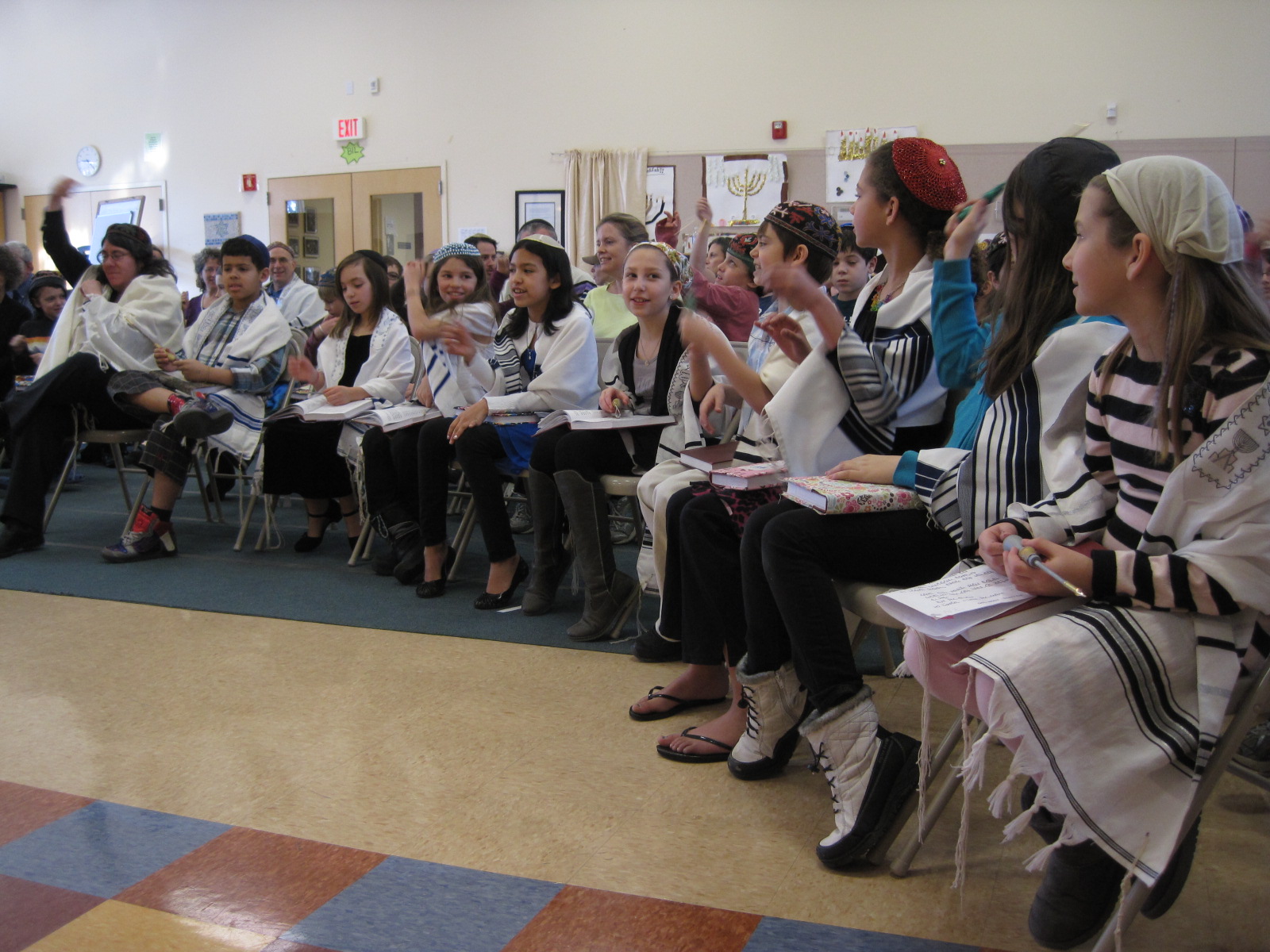
A few weeks ago, our 4th grade students proudly and loudly attended tfillot (services) on a Thursday morning where for the first time they stood up and each chanted a pasuk (verse) of Torah. Their parents held a tallit above their heads as each child proudly showed off their new skills. Moreh Aharon Skoglund spent months preparing our students for this day. In September, Moreh Aharon introduces to the 4th graders the various torah trope markings. Now if you have never read torah you can't appreciate the fact that torah trope looks like a bunch of scribbles on top or bottom of Hebrew letters. Each trope mark symbolizes a different note that the reader must chant. It is can be complex and challenging for many people who do it. But it is a skill once mastered is something that is quite impressive to know. Many day schools teach their students how to read torah but not many try it at the 4th grade level. The fact that LGA makes this commitment to teaching our students this skill shows our commitment to Jewish learning as a lifelong venture. This is both academically challenging and progressive.
Now here's the thing - every single student succeeds. Our faculty work individually with students to make sure there is maximum success. Some read shorter pasukim and others have more intricate verses to chant. But each student and family is proud of both the individual and the collective. This is child-centered. Bingo, we have all three. And did I mention that in art class each student designed their own yad (pointer) for this special occasion? It doesn't get much better than that...
Now take our Gan (Kindergarten) classroom. Morah Amy Meltzer guest writes for a few moments about a unit that her class explores. Here's what Amy writes...
"This was a week devoted in part to the exploration of wood and the creation of what proved to be some spectacular wood sculptures. Inspired by Cathy Topal's book Beautiful Stuff, which guides much of my thinking about art in the Gan, I decided it was time to haul in the three boxes of wood scraps I've been collecting for the past year and give the Gan a chance to get elbow deep in sawdust.
We spent a day or two exploring what we had, and giving children a chance to experiment with ways to arrange, balance and create with pieces of wood. We spent one class session on Tuesday thinking about ways to sort our wood, and later that day learned how to use sandpaper to smooth the wood. By Wednesday, everyone was eager to start gluing. Children started by using wood glue to create a sturdy base with three or four large pieces. From there, some sculptures grew wider, while some grew taller. Some children told stories of pirates and train stations with their wood, and some children worked on making something beautiful..."
From there the Gan students met with their Kitah Vav (6th grade) buddies. Last week, each pair sat down and worked on describing their piece. The sixth graders were the note takers while the Gan students explained their pieces in much detail. This morning in the library, parents and guests were treated to a real Gallery opening. Pieces were displayed. A guest book was there for patrons to sign in and send their well wishes to the artists and there of course was a nosh (as any good art opening would have.)
Again this unit highlighted all three objectives. It was academically challenging. Each student was asked to reach inside themselves. It was child-centered. Wow...could a child get their creative juices flowing on this one. It was progressive. Imagination ruled the day yet there were standards and expectations for each student.
Finally, later this week, our 2nd grade students will be having their Chagigat Siddur where each student will receive their first siddur (prayerbook). If you have never been to this ceremony, it's a good one to come to. Each 2nd grader shares with us a few of their own words about a prayer. I am looking forward to hearing the eighteen or so pieces on Jewish thought and spirituality. For many of these students, this is the first time they are really thinking about how prayer influences their lives. Those three goals are met yet again.
I look forward to finding more ways that we succeed with these goals...
The past few weeks I have witnessed all three in different ways here at LGA. Each inspired our educators and students to think creatively about what the end goal of learning should be or how each students gets to that goal.
A few weeks ago, our 4th grade students proudly and loudly attended tfillot (services) on a Thursday morning where for the first time they stood up and each chanted a pasuk (verse) of Torah. Their parents held a tallit above their heads as each child proudly showed off their new skills. Moreh Aharon Skoglund spent months preparing our students for this day. In September, Moreh Aharon introduces to the 4th graders the various torah trope markings. Now if you have never read torah you can't appreciate the fact that torah trope looks like a bunch of scribbles on top or bottom of Hebrew letters. Each trope mark symbolizes a different note that the reader must chant. It is can be complex and challenging for many people who do it. But it is a skill once mastered is something that is quite impressive to know. Many day schools teach their students how to read torah but not many try it at the 4th grade level. The fact that LGA makes this commitment to teaching our students this skill shows our commitment to Jewish learning as a lifelong venture. This is both academically challenging and progressive.
Now here's the thing - every single student succeeds. Our faculty work individually with students to make sure there is maximum success. Some read shorter pasukim and others have more intricate verses to chant. But each student and family is proud of both the individual and the collective. This is child-centered. Bingo, we have all three. And did I mention that in art class each student designed their own yad (pointer) for this special occasion? It doesn't get much better than that...
Now take our Gan (Kindergarten) classroom. Morah Amy Meltzer guest writes for a few moments about a unit that her class explores. Here's what Amy writes...
"This was a week devoted in part to the exploration of wood and the creation of what proved to be some spectacular wood sculptures. Inspired by Cathy Topal's book Beautiful Stuff, which guides much of my thinking about art in the Gan, I decided it was time to haul in the three boxes of wood scraps I've been collecting for the past year and give the Gan a chance to get elbow deep in sawdust.
We spent a day or two exploring what we had, and giving children a chance to experiment with ways to arrange, balance and create with pieces of wood. We spent one class session on Tuesday thinking about ways to sort our wood, and later that day learned how to use sandpaper to smooth the wood. By Wednesday, everyone was eager to start gluing. Children started by using wood glue to create a sturdy base with three or four large pieces. From there, some sculptures grew wider, while some grew taller. Some children told stories of pirates and train stations with their wood, and some children worked on making something beautiful..."
From there the Gan students met with their Kitah Vav (6th grade) buddies. Last week, each pair sat down and worked on describing their piece. The sixth graders were the note takers while the Gan students explained their pieces in much detail. This morning in the library, parents and guests were treated to a real Gallery opening. Pieces were displayed. A guest book was there for patrons to sign in and send their well wishes to the artists and there of course was a nosh (as any good art opening would have.)
Again this unit highlighted all three objectives. It was academically challenging. Each student was asked to reach inside themselves. It was child-centered. Wow...could a child get their creative juices flowing on this one. It was progressive. Imagination ruled the day yet there were standards and expectations for each student.
Finally, later this week, our 2nd grade students will be having their Chagigat Siddur where each student will receive their first siddur (prayerbook). If you have never been to this ceremony, it's a good one to come to. Each 2nd grader shares with us a few of their own words about a prayer. I am looking forward to hearing the eighteen or so pieces on Jewish thought and spirituality. For many of these students, this is the first time they are really thinking about how prayer influences their lives. Those three goals are met yet again.
I look forward to finding more ways that we succeed with these goals...
Monday, January 30, 2012
Showing our Schechter pride...
Recently, an article was published in the Jewish Daily Forward (http://www.forward.com/articles/149983/?p=all) about the decline of Solomon Schechter schools in North America. LGA was singled out as a school of growth. Our own, Morah Devorah Bromberg Seltzer quoted accolades about what we are doing right and for a little while I basked in the glow of our position in an otherwise gloom and doom piece about Jewish day schools and dwindling enrollment.
I know that many parents in the LGA community read this article with much excitement. When word spread that LGA made the national press, everyone was elated but as I and others further examined the article we definitely saw it as a double edged sword. A few of you commented to me that the article really didn't paint an accurate picture of Jewish day school life and were a bit astonished by the tenor of the negative article questioning why was it so negative. Is LGA such a unique Schechter school?
While, yes, LGA has a unique place on the Schechter landscape. Our video that we submitted to the Avichai Foundation captures our essence and spirit. (You still have time to vote and encourage your friends and family as well.) http://www.dayschoolvideoacademy.org/VideoView.aspx?MovieId=172. We are not unique because LGA as all other Schechter schools are guided by a set of expectations that help all of us frame for our students ways to live a Jewishly rich life all the while teaching about being concerned global citizens. All Schechter schools hold very tightly to the ideal of academic excellence at the core of their mission. I don't think there is a school in the network that doesn't believe that this is central to our success. Our constituencies wouldn't have it any other way.
I have had the privilege of walking into many different Schechter schools and working closely with other heads of schools at Solomon Schechter day schools throughout North America. We each "do" Schechter differently. 43 different ways. This is what I have learned to love about our movement of schools. Whether it is Solomon Schechter of Greater Boston, Gross Schechter in Cleveland, or Community Day School in Pittsburgh, or any of the other schools in the movement, many of our schools are the pride of our greater communities because of our focus on the whole-child, the diversity of our community is astounding and who our graduates become.
Schechter schools get a bad rap. Being a movement affiliated school, we are guided by principles yet are given enough leeway to understand and support local cultural mores and standards making us true community schools. LGA is a fine example of that and something that the entire Pioneer Valley is very proud of. With pride, we hold our head up proudly as a Schechter school.
I know that many parents in the LGA community read this article with much excitement. When word spread that LGA made the national press, everyone was elated but as I and others further examined the article we definitely saw it as a double edged sword. A few of you commented to me that the article really didn't paint an accurate picture of Jewish day school life and were a bit astonished by the tenor of the negative article questioning why was it so negative. Is LGA such a unique Schechter school?
While, yes, LGA has a unique place on the Schechter landscape. Our video that we submitted to the Avichai Foundation captures our essence and spirit. (You still have time to vote and encourage your friends and family as well.) http://www.dayschoolvideoacademy.org/VideoView.aspx?MovieId=172. We are not unique because LGA as all other Schechter schools are guided by a set of expectations that help all of us frame for our students ways to live a Jewishly rich life all the while teaching about being concerned global citizens. All Schechter schools hold very tightly to the ideal of academic excellence at the core of their mission. I don't think there is a school in the network that doesn't believe that this is central to our success. Our constituencies wouldn't have it any other way.
I have had the privilege of walking into many different Schechter schools and working closely with other heads of schools at Solomon Schechter day schools throughout North America. We each "do" Schechter differently. 43 different ways. This is what I have learned to love about our movement of schools. Whether it is Solomon Schechter of Greater Boston, Gross Schechter in Cleveland, or Community Day School in Pittsburgh, or any of the other schools in the movement, many of our schools are the pride of our greater communities because of our focus on the whole-child, the diversity of our community is astounding and who our graduates become.
Schechter schools get a bad rap. Being a movement affiliated school, we are guided by principles yet are given enough leeway to understand and support local cultural mores and standards making us true community schools. LGA is a fine example of that and something that the entire Pioneer Valley is very proud of. With pride, we hold our head up proudly as a Schechter school.
Subscribe to:
Posts (Atom)